Tuesday, July 16, 2013

In Africa X


X

President Obama Comes to Dar; Mikumi; Saba Saba; A Postscript

In late March of this year Chinese President Xi Jinping visited Dar es Salaam and dedicated the Julius Nyerere (first president of Tanzania) International Convention Center paid for with Chinese funds. There were news stories about the visit at the time, there was talk on the street, but there was no significant fanfare. The downtown was not closed to traffic; there were no signs with the Chinese president’s picture on it. It was a relatively low-key event. On June 30, 2013, President Obama arrived in town. Security in the city center was so tight that workers were advised to avoid the downtown area beginning the Friday before the visit. The entire Hyatt Regency Kilimanjaro Hotel was taken over by US personnel accompanying the President. And most noticeably, every street in the city center and those over which President Obama would travel were adorned with posters - on every lamppost - of President Obama. Above the picture were flags; one American flag and One Tanzanian flag. Roads with potholes had been hastily repaired. They city was abuzz with the excitement.
As we drive to Mikume
Adding to what was already considered to be a monumental event was the “African First Ladies Summit” hosted by the George W. Bush Institute. The event was attended by George W. and Laura Bush, Michelle Obama, and many African first ladies. The President and former president jointly laid a wreath at the site of the former US Embassy that was bombed by terrorists in 1998.

SAUL LOEB/AFP/GETTY IMAGES

What was most interesting about this combination of events was not the fact that President Obama is hugely popular in this part of the world, or that the city was virtually “locked down” from the security incident to the simultaneous visit of a sitting American President and a former U.S. president, or even the thousands of pictures and billboards of the American President everywhere in town. What made all of this interesting to me was that the Chinese are pouring much more money into Tanzania and all of Africa than is the United States. One of George W. Bush’s legacies will surely be the health initiative he started in Africa to fight HIV and Malaria, spending more on the continent than any other U.S. president. President Obama is following with an energy program with a goal to bring continuous electric power to all people in Africa. These are small in comparison to the Chinese investment, but it seems that the people of this continent, long neglected by the U.S., are more excited about the American investments they are now getting, than they are about the massive investment being made by the Chinese.
Downtown along Ohio Street
Regardless, it was definitely a time to be out of Dar es Salaam, if that was possible. For me, it was. Unexpectedly I was requested to attend the opening of a training being conducted at the Police College in Kidatu, a remote area west of Dar. The 30th of June was our wedding anniversary. In recent years we have done a lot of interesting and different things for our anniversaries due to the nature of my work. This may be the most unusual. We left early Sunday and traveled the six hours to the Police College. It sits high on a mountain in an area owned by the energy company of Tanzania. We stayed in a guesthouse offering a panoramic view of the acres and acres of sugar cane being grown by the joint public – private venture, Kilombero Sugar Company.
Sugar cane plantation
View from Police College

Baboons begging on the road to Police College
There were some evening protocol events for us upon arrival followed by the opening ceremony on Monday morning. The event ended around noon. Rather than make a second grueling drive six hours or more back to Dar es Salaam we had arranged to stay at a lodge near the entrance to the Mikumi National Park, an hour or so on the way back to Morogoro and Dar.
Narrow bridge across the river
We arrived mid afternoon where we settled into the bungalow we rented for the night. It was a pleasant place and was recommended by friends as a good place to stay in that area. The hotel arranged a morning safari drive through the park in one of their vehicles. The rest of the afternoon we spent relaxing.
Bungalow at the Tan-Swiss Lodge
While eating our late lunch we witnessed a phenomenon that is rarely seen in our own country. The television on the wall of the open air bar was showing the events of the prior day when President Obama arrived at the Julius Nyerere airport in Dar es Salaam. As the program began the entire hotel staff filed into the bar area close to the television, this included wait staff and kitchen staff. Fortunately our meal had already been served. The hotel staff watched the entire hour or so re-play of the President’s arrival. For us it was a humbling experience and at the same time one that made us feel proud of who we are. The Tanzanians for their part felt honored, and I believe they also felt a sense of pride that the American President was visiting their country. It was a nice afternoon.
Hotel staff watching the ceremonies at the airport

Mshamu is eating lunch,
but he was craning his neck to see the television.
The waitress offered him a seat with a better view. 
The early morning marked our first ever trip through a game park. The main road over which we traveled runs between Dar es Salaam and Iringa and actually cuts through the park. Driving to the park entrance on that road we saw impala, zebra and giraffes. The hotel vehicle has benches in the back to allow us to see the wildlife unrestricted yet safely. Our guide/driver was also provided by the hotel. Our personal driver, Mshamu, took the safari drive along with us.
Giraffes along the main road

At Mikume Park

A zebra crosses in front of us


Impala
Mshamu in a baobob or boaboa tree

Buffalo

Warthogs

Elephants
Mikumi is neither the largest nor the most popular of the many National Parks in Tanzania, but at 3,230 sq. km (1,250 sq miles), it is the fourth-largest park in Tanzania, and part of a much larger ecosystem centered on the uniquely vast Selous Game Reserve. Although we only saw two of the ”Big Five”, the elephant and buffalo, it was exciting to see so many other animals in the wild. The “Big Five” refers to the lion, elephant, buffalo, rhino and leopard and is a term originally invented by big game hunters based on how difficult each animal was to hunt. The expression is still used by tourists and wildlife guides. We were able to see a very large buffalo herd, easily several hundred animals, as well as a few individuals. We saw several groups of elephants. Zebras, giraffes and impalas were abundant in the park. Warthogs, wildebeest, hippopotamus, crocodiles, baboons, exotic birds; the wildlife was everywhere and we were able to get very close to the animals we saw. Mshamu was disappointed, however, that we did not see simba (lion); perhaps on another trip.
Crocodile
Wildebeest

Duck

Buffalo
Saba saba, or seven seven; the seventh of July, is a holiday here. This year it was on a Sunday so there was no holiday from work. Saba Saba is also the name of a large trade fair in Dar es Salaam held each year on 7 July. At the Dar es Salaam yacht club the annual Saba Saba sailboat race is held as it has been for many years. The race begins at the very point of the Msasani Peninsula and races around the point into the harbor at Dar es Salaam and

Harbor at Dar es Salaam

Ship arriving but we are out of the way

On the run back home
back out and around to the yacht club. I was able to crew on a 27 foot boat for the race. The wind was brisk, the ship traffic light and the race uneventful, except for the excitement of sailing. Well, our boat, Kusi, did have a bit of excitement out of the ordinary. As we attempted to fly the spinnaker on the run back from the harbor, the sail became fowled in the rigging and it took us a half hour or so working in 25 knots of wind and six foot swells to get it down. Seems someone had not properly rigged the halyards. Such is life aboard sailboats. Kusi finished dead last in the fleet of five boats. There is always next year.

Until Next Connection,
Dan

Postscript: The man who begs at the Village Supermarket and has the leg that appears to have been broken and healed wrong, leaving an unusable grotesquely shaped lower limb, may finally get his problem orthopedically corrected. Sharon gave him her usual 1000 shilling note and he stopped her to ask her to sign a pledge from some orthopedic clinic where he can get corrective surgery once he collects enough pledges. Someday he may actually return to being a productive member of Tanzanian society. We wish him well.

Saturday, June 29, 2013

In Africa IX


IX

Woodcarvers, Woodworkers

Everyone has seen and many people own the amazing carvings from Africa, especially those from the coal black, dense, heavy wood, ebony. Here in Tanzania, the prices for these magnificent pieces of art are very reasonable and always negotiable. I have often wondered whom these artists are that carve these pieces. There are many of them. We spend time looking through the numerous small shops stretching along the highway Sam Nujoma Road in the Mwenge area of Dar es Salaam.
Wood carving shop. Carvings larger than life

Carvings of Maasi

The best I can tell, there are three levels of people in the Mwenge Woodcarvers Market; the people who own the shops, the woodcarvers and the “brokers” for lack of a better term. It is the brokers who usually make the initial contact with potential customers. As Mzungus, arriving as we usually do on a slow Sunday afternoon, we are assured of getting a lot of attention from those selling the wares. The brokers try to determine what we are looking for and then direct us to appropriate shops. They stay with us as we stop along the long line of small narrow shops. They know the process, or at least they freely quote prices. We have learned that if we speak to the owner of the shop, the starting price is usually much lower. Maintaining this discrepancy is obviously how the brokers make their money.
Young "broker"

Maasi Village carving
It is the shop owners who have the relationship with the carvers. It is hard to tell if the carvings are consigned to the shop owners by the carvers or purchased or possibly some combination or even a different arrangement. Regardless we are always greeted at each shop with the familiar “karibu – welcome.”
Karibu
The most interesting of all the players at the woodcarver’s market are the carvers themselves. They have impressive talent and yet are at the very bottom of the marketing scheme. One of the brokers took us out the back door of a shop to the area behind, where the carvers work. Their tools are basic; chisels and something to use as a hammer. No benches, clamps or vices. Hands and feet hold the wood while it is transformed into lions, elephants, people, crocodiles, buffalo, and whatever you or they can imagine. The work areas are under overhangs and metal shed roofs off the backs of the shops. Sometimes they simply work in the open. Small fires heat food for the carvers, tended by a few women. The carvers are all men.
Apprentice with "monkey chain"
Woodcarvers. Large work in progress

It is an absolute wonderment to watch these men work. Apprentices begin with smaller pieces; clubs, inter-linking hanging monkeys, etc. The more accomplished carvers sometimes spend months on carvings that stand eight or more feet and are extremely intricate. Life size statures of people mainly Maasi; some even larger than life. A popular carving is what is often referred to as the family tree. It is basically a piece of wood – a log sometimes that is carved into numerous people all connected from bottom to top, inside and out and around the circumference of the wood. Larger diameter pieces have several dimensions. There are people on the inside as well as the outside, and they all rise to the length of the wood several people high. One unfinished but phenomenal piece we saw behind the shops took six months to get to the point where it was when we observed it. It stands eight feet tall and has a diameter increasing from bottom to top of three to four feet. The carving starts in the center of the log and works out to the outside layer. Thee “family tree” type of carvings depict life in the villages and show people doing many different daily chores.
This family tree took six months so far


Even more fascinating than the carvings, was what we saw in a common gathering area under a corrugated tin roof. There was a chalkboard at one end of the area. It had words written on it. At the top was “English” below, quite obviously, was an English lesson – which itself was not precise English. It was impressive that they were taking time to teach the carvers some basic English skills to assist them in their work and future work. Some carvers ultimately own a shop or become “brokers.” English skills are essential to success in that event.
Carver's common area

They learn English


Carvers will sell direct to customers. Customers, however, seldom see the carvers. We were fortunate. If you do buy from the carvers, you receive the very best price. Even if you do not buy and just want to take a picture of this fascinating cultural artifact, a small gratuity is expected and, in our case, gladly offered. 

There are other woodworkers in and around Dar es Salaam. Some work in shops, usually owned by foreigners, making dhow furniture. Dhow furniture is furniture made from old dhow boats. The wormholes, natural curves, and rustic look of the weathered dhow wood have a popular if not irresistible appeal. We don’t own one, but shelves made from the bow of an old dhow are the most popular form of dhow furniture. We have a chaise lounge and a swing made from dhow wood. They are interesting to look at and functional to lounge on.
Lounge from old dhow boats. 

We have also purchased items from vendors who set up alongside the busier roads. Interestingly, n these roadside open-air markets, the price drops as you walk from the very roadside back into lesser-visited parts of the market. We found the builder of some small folding tables tucked behind the vendors and down in a depression between the roadside and a wall. We got the best price from him and he finished the second of two tables we purchased from him while we waited.
Dhow swing on right. folding table on left
(neighbors' heavy dhow chairs in back)

Some woodworkers have more permanent facilities. There is a small sign on the ground leaning against a wall in a narrow unmarked alley on our street advertising a woodworker. Curious, we stopped and walked the few hundred feet to the non-descript shop. They were building beds; headboards, sideboards, and footboards. The craftsmanship was excellent. There were some saws, but virtually all of the work was done with hand tools. The owner showed us pictures of his prior work, including kitchen cabinets, tables, chairs and beds. He will build to order whatever you need.
Woodworker's shop near our house


Bed headboard in progress

Bed footboard

Watching the woodcarvers and woodworkers is a refreshing yet troubling step back in time. Skills we have nearly lost to the electronic/mechanical age seem to thrive here. In Western cultures we cannot afford the cost for the labor needed to produce these products. Here, that cost is negligible.


Until Next Connection,
Dan


Monday, June 17, 2013

In Africa VIII


VIII
Ngalawa Races; Street Vendors


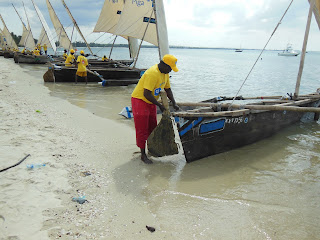
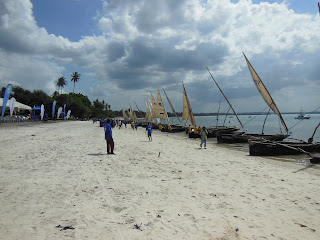
Tanzania is the first country in the history of water sports to have a ngalawa (dhow) competitive race using International Sailing Federation (ISAF) rules and regulations. According to Wikipedia, ngalawa is a traditional, double-outrigger canoe of the Swahili people living in Zanzibar and the Tanzanian coast. It is usually 5-6 meters long and has two outriggers, a centrally-placed mast (often inclining slightly towards the prow) and a single triangular sail. Many of these boats sail from the beach in front of our house. The fishermen use them.
Ngalawas ready for the race
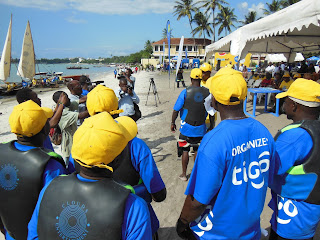
Skippers meeting pre-race
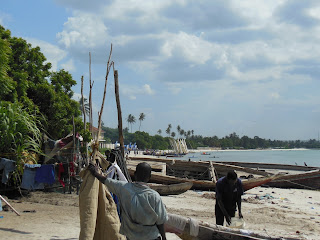
The race took place on a beach a few hundred yards down from our house. This was the first time we had actually ventured out the gate onto the beach and through the fishing village that exists outside our wall. The village is a cluster of a few shelters built from whatever has been available. The main focus of the people there is the sea, their boats, and fishing. Small fires heat water and cook food. Lines strung between the few trees on the beach dry clothes. The path takes a winding route along the narrow strip of sand which these traditional people occupy. Finding ourselves amidst the shelters themselves, we opted to abandon the path and continue along the waterline on the beach. Ducking under lines holding beached vessels to the shore and wading around others we were soon at the site of the event.
Walking our beach
crew steadying the boat
putting on his ridder and striking a pose
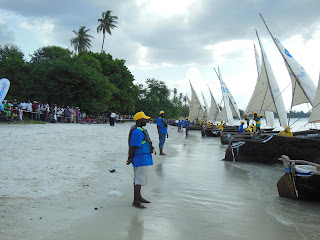
The ngalawas lined the shore facing out to the bay minded by crew who would occasionally have to re-secure them to the sand ahead of the advancing tide. There were twenty or so. The skippers were gathered in a group variously engaged in skippers meetings with race officials to confirm the racecourse and rules, and otherwise waiting for the race to begin. The race included official sponsors who provided new sails for each entrant and tee shirts for the captains and crew; the former in blue and the latter yellow. Each entrant was given a small stipend to help them prepare for the race and cash prizes would be awarded to the first three official finishers.
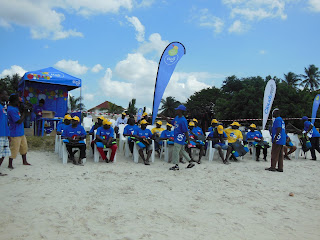
The skippers

Putting the rudder on. It won't be long now!
Introducing the skippers
We spoke to the Norwegian couple who organized the race. They said that they felt that the culture of the fishermen of Tanzania was being lost because people were actually unaware of its existence. The dhows are prominent all along the coastline, but the true essence of the fishermen’s lives is not so readily apparent. We have the village stretching from our house to the fish market down the shore. We watch daily what they do and how they live. The publicity from the race, they felt, would bring attention to the lives of the fishermen, the richness and historical significance of their culture, and to the problems they face today trying to sustain that traditional way of life.
Last minute preparations

The skippers wait for the horn

The Dar es Salaam Yacht Club, across the bay from the race start, provided marks, committee and umpire boats for the race. The Tanzanian Minister for Information, Culture and Sports made some opening remarks. The Captains were then each introduced after which they joined their crews. As the horn sounded, the boats were pushed off beach and into the water; the race began.
The race begins
Smooth start for most
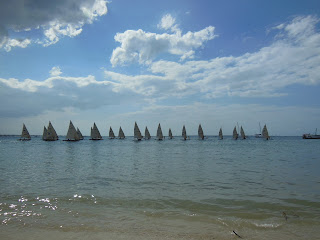
The boats themselves are made from logs. They often have the appearance of being totally unseaworthy, but optimism exudes from the names and markings brightly painted on the weathered hulls. They move through the water swiftly and the captains and crew are skilled sailors. The fleet remained in a tight formation through the first turn at the first mark. Then, as in most yacht races, the sails separated across the skyline like opening a fan, as the speed of the hulls and skills of the crews were tested in time honored fashion.
Close quarters at the start
Rounding the first mark
There was a winner, and a second and third place; but the first and second to finish, both well regarded and skilled sailors who beached their craft to the cheers of a large crowd, were both disqualified for having missed marks during the race. At the awards ceremony, a detailed explanation of the rules and their importance was given to the crowd before the winners were announced. By all accounts, the people were pleased that rules were in fact followed. Some speculate that because too often in Tanzania, rules are broken or not enforced based on things political or financial, the adherence to them in this new venture was actually appreciated.
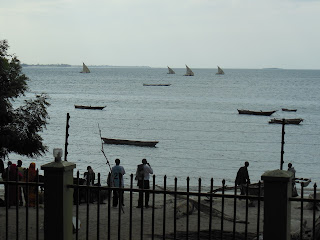
The race
As they sailed past our house in the evening after the race, even from our vantage on our rooftop terrace, the pride of the sailors could be seen on the faces and in the demeanor of the crews as they sailed past. They knew that even though they are poor fishermen who risk their lives each day to eke out a living, they had earned the respect of every spectator at the event that day.
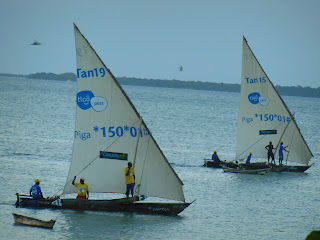
Sail-by after the race


Merely eking out a living is something that the vast majority of Tanzanians do. Small wages for hard work is the norm. Whether it is the drivers, the maids, or the street vendors, earning a living wage is difficult.
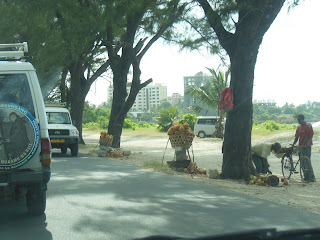
Selling coconuts for the milk 

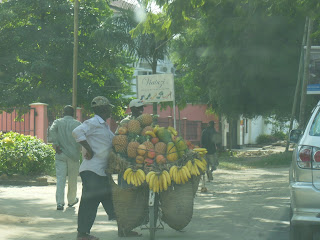
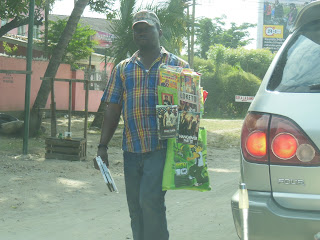
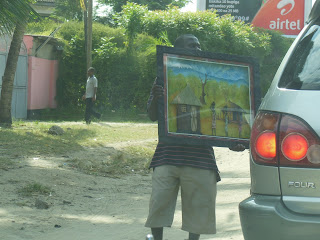
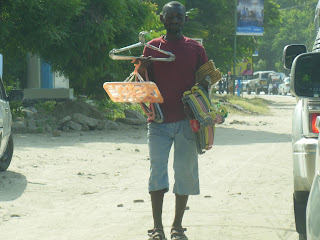
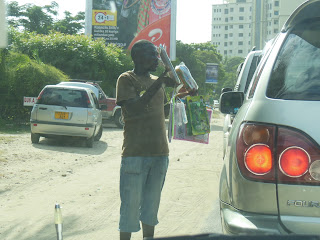
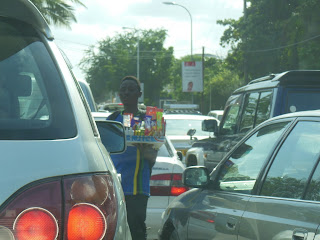
The street vendors are all over the streets of the city center, some with tables set along the sidewalks, others standing or walking about. The sellers of gum, single cigarettes and mints all have the same distinctive way they hold and click the coins together in the palm of their free hand as they walk the streets of the city. Of all the vendors, I am most fascinated by those who ply the daily traffic jams. In the true sense of making good fortune out of someone else’s bad fortune, the vendors in the traffic jams provide a means of buying anything and everything that is sold in stores without having to make the trip. It is easy to sit and brood while caught in a traffic jam for a half an hour or more. Brooding does not help the traffic move, nor, does it seem, do the traffic police trying to manage it all. Better to shop.
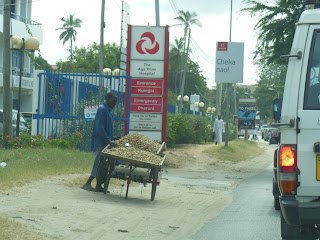
 
Peanuts in the shell

Fruit

I have purchased fruit, floor mats for the car, electrified tennis rackets to zap mosquitos and other items while sitting in the car waiting to move. Newspapers, magazines, CDs, DVDs, DC power cords, hats, shoes, clothes, candy, ice cream, fruit, coconuts, water, soda, belts, car floor mats, the requisite red triangle and fire extinguisher for the car, car jacks, tables, pictures, cashew nuts, potato chips, toys, maps of Tanzania, virtually anything you may need is available from a vendor in the traffic jam; and the prices are negotiable as well. No need to worry if the traffic moves in the middle of a transaction, the vendor will catch you up as soon as the car stops again.
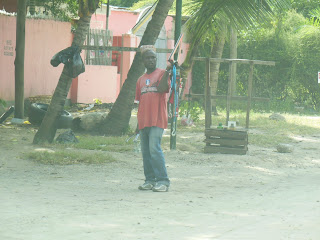
Triangles, jacks, things for the car

Phone chargers for the car

DVDs

Picture

Clothes hangers

Toys

Treats

Potato chips

The beggars are there too. There are, the ones with deformities, most, easily corrected with surgery unavailable to them, the ones who cannot walk but have been given the three wheeled tricycles propelled by hand power, and of course, the women with babies. The street here presents the best and worst of humankind; human ingenuity at its best as vendors make a living selling; and human neglect where those who have been cast off as useless are relegated to begging for their survival. Social Darwinism is now in place in this former Socialist state. One last thought about the traffic jams. I follow the route that the Prime Minister takes daily to and from his work. As the sirens screech, the cars pull over, and the motorcade carrying the Prime Minister to his home passes undaunted. The contrasts here are extreme.

Until Next Connection,
Dan